


August 2025
“Amós” – Sistema y Reforma de la Justicia Social
Por Rev. Dr. Esteban Rodriguez
Amidst the noise of a society reeling from pandemics, economic crises, and broken systems, we hear an ancient echo resounding loudly: the voice of the prophet Amos. He did not speak from palaces or temples, but from the fields, from the land where injustice is felt in the flesh. Today, that voice rises again, not as a distant cry, but as an urgent whisper in our hearts.
We live in times of pain. The COVID-19 pandemic has not only left physical scars but has also laid bare the fragility of our social structures. Families torn apart, jobs lost, dreams shattered. And as if that were not enough, a new pandemic—one of fear and uncertainty—looms over millions of immigrants who wake up every day hoping to return home, to hug their children, to fulfill the sacred duty of supporting their loved ones.
Where is the church? Where is the prophetic voice that dares to say, “Enough!”?

Amos, the shepherd from Tekoa, confronts us: “Hear this, you who trample the needy, to do away with the humble of the land.” (Amos 8:4). Isn't this the same denunciation we should be making today? Racism, labor inequality, institutionalized greed, and a judicial system that imprisons without mercy some while easily exonerating others. Where is the church? Where is the prophetic voice that dares to say, “Enough!”?
History reminds us that God is not indifferent. When Pharaoh oppressed Israel, God said, “I have seen... I have heard... I have known... and I have come down” (Ex. 3:7-8). Doesn't God expect the same from his church today? That it sees, hears, knows, and descends into the pain of his people. Martin Luther King Jr. dreamed of a church that would not only preach from the pulpits but march in the streets, that would get its hands dirty for justice. Have we lost our spiritual sight and hearing today?
Nehemiah teaches us that true leadership listens to the cries of the people. In the midst of reconstruction, he stopped his work to care for the oppressed. He did not see them as statistics but as brothers and sisters. Can we do the same?
Justice is not a secondary issue in the Bible; it is at the heart of God's message.
Amos was not diplomatic. He was courageous. He denounced corrupt judges, cheating merchants, and complicit religious leaders. His message was not comfortable, but it was necessary. Today, his prophetic spirit should ignite our consciences. Justice is not a secondary theme in the Bible; it is the heart of the divine message. From Moses to the prophets, from Job to the Psalms, justice reflects God's character.
Micah said it clearly: “I am filled with power—with the Spirit of the LORD—and with justice and courage to make known to Jacob his rebellious act” (Micah 3:8). Where are the Micahs today who dare to speak with authority?
Transformational evangelical advocacy is not just a theory. It is a call to action, to be intentional witnesses who challenge injustice and promote human flourishing. As René Padilla rightly said, the gospel is a public message. It cannot remain locked within the church's walls. It must go out, it must walk, and it must speak in the places where the destiny of the majority is decided.
Jesus understood this. His ministry was not only spiritual but also comprehensive. He healed, liberated, and comforted. His agenda was humane, complete, and redemptive. That ministry is still valid today. The church, as his body, has a responsibility to continue such ministry: to preach good news, to bind up broken hearts, to free captives, and to comfort those who mourn.
Spirituality that does not touch social reality is incomplete. - Eldin Villafañe
Eldin Villafañe reminds us that authentic spirituality must be comprehensive. It is not enough to fight against the flesh, the world, and the devil in private. We must recognize sinful social structures, the principalities and powers that oppress from above. Spirituality that does not touch social reality is incomplete.
Today, Amos is calling us. He calls us to see, to listen, and to act. He calls us to be church in the deepest sense: a prophetic community, a voice for the voiceless, a light in the midst of darkness. Let us no longer remain silent. Let us be the remnant that rises with justice, with compassion, with power.
Acerca del Autor
Rev.
Esteban
Rodriguez
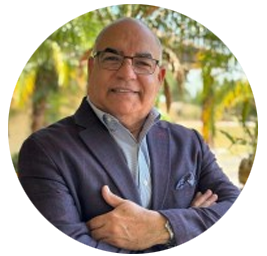
Rev. Dr. Esteban Rodríguez is the lead pastor of Centro Cristiano El Pan de Vida in Kissimmee, Florida. He holds a Doctor of Ministry from Western Theological Seminary and is dedicated to developing leaders and supporting families in both faith and community.
